Nayya Intelligence

Trusted, defensible Benefits Intelligence

Nayya Intelligence is the health and wealth engine built for the enterprise benefits experience.

From Complex Benefits Data to Accurate and Personalized Guidance

Nayya Intelligence orchestrates multiple layers of data, benefits structure, and claims expertise to provide personalized Recommendations, Nudges, and Actions for every employee.

Nayya Intelligence

orchestrates
Unified
Data
Benefits
Structure
Claims
Intelligence
Security
Expert
Review
Recommendations
Nudges
Actions
This is some text inside of a div block.

Benefits Intelligence that knows each employee

I've been having terrible lower back pain for weeks. Should I get an MRI, see a chiropractor, or go straight to an orthopedic surgeon? How much is this going to cost me?
Anna Smith
Answer without Nayya
The cost of an MRI can vary widely, typically ranging from $400 to $3,500 depending on your location and insurance. Seeing a specialist usually requires a copay or coinsurance.
Answer with Nayya IntelligenceTM
You're on a High Deductible Health Plan with $850 left on your deductible. An orthopedic consultation will run about $125 out-of-pocket. I see you have $1,100 available in your HSA, so you can cover the entire amount using tax-free dollars without impacting your monthly budget.

For your location, Dr. Sarah Jenkins is in-network (BlueCross BlueShield PPO), has top-tier quality ratings for spine care, and is highly cost-efficient.
Should I be doing anything with HSA?
Anna Smith
Answer without Nayya
HSAs are a great tax-advantaged savings tool. The 2025 contribution limit is $4,300 for individuals. You can invest your balance once it reaches a certain threshold. Consider maxing it out if you can.
Answer with Nayya IntelligenceTM
You're currently on the PPO, which means you can't make new HSA contributions right now.

Based on your last 12 months of claims, about $1,100, you're actually a strong candidate for the HDHP. It would have cost you less overall last year, and it would lower your premium by $142/month. If you make that switch during Open Enrollment, you're looking at roughly $890 in tax savings this year alone, and over 10 years, that balance could grow to $47,000+.
What's the right amount of life insurance coverage, now that we'll have a child?
Anna Smith
Answer without Nayya
Most new parents are advised to carry 10–15× their annual income in life insurance coverage, though the right amount depends on your debts, savings, and how many years your family would rely on your income. A 20- or 30-year term policy is typically the most affordable option for young families.
Answer with Nayya IntelligenceTM
Based on your $150,000 salary, you already have $300,000 in basic life insurance through Acme, with the option to add up to $1,200,000 in supplemental coverage, bringing your total potential employer coverage to $1,500,000.

For a newborn dependent, most financial planners recommend covering 15–20 years of income replacement. For you, that's roughly $2,250,000–$3,000,000, add your $158,595 in outstanding debt and a college fund estimate of ~$240,000, then subtract your existing assets ($195,126 across retirement, cash, and emergency savings). Your total coverage target lands around $2,500,000–$3,500,000.

That gap between your employer coverage and your target is best filled with a 20- or 30-year term policy, which will cover your child through financial independence and is more affordable than whole life.

Built to meet enterprise standards

With your consent, Nayya connects directly to the carriers and HCM platforms that hold your benefits data, including ADP, Workday, MetLife, Guardian, and Prudential, and delivers intelligence through the channels employees already use, from Slack and Teams to Claude and beyond.
HRIS
Channels
Data sources

Integrated with existing systems

Real-time benefits intelligence requires real data. Nayya has spent years building direct data agreements with the industry's major carriers and HCM platforms and carrier partners to receive plan, eligibility, and cost data in real time.

Meet employees where they are

Employees access Nayya Intelligence wherever they already work, such as Slack, Microsoft Teams, Claude, and more. No matter where they ask, the answer is always grounded in their actual plan, not general guesses.

AI-assisted implementation

Turn plan documents and handbooks into actionable data using Nayya's AI-assisted implementation with humans in the loop.
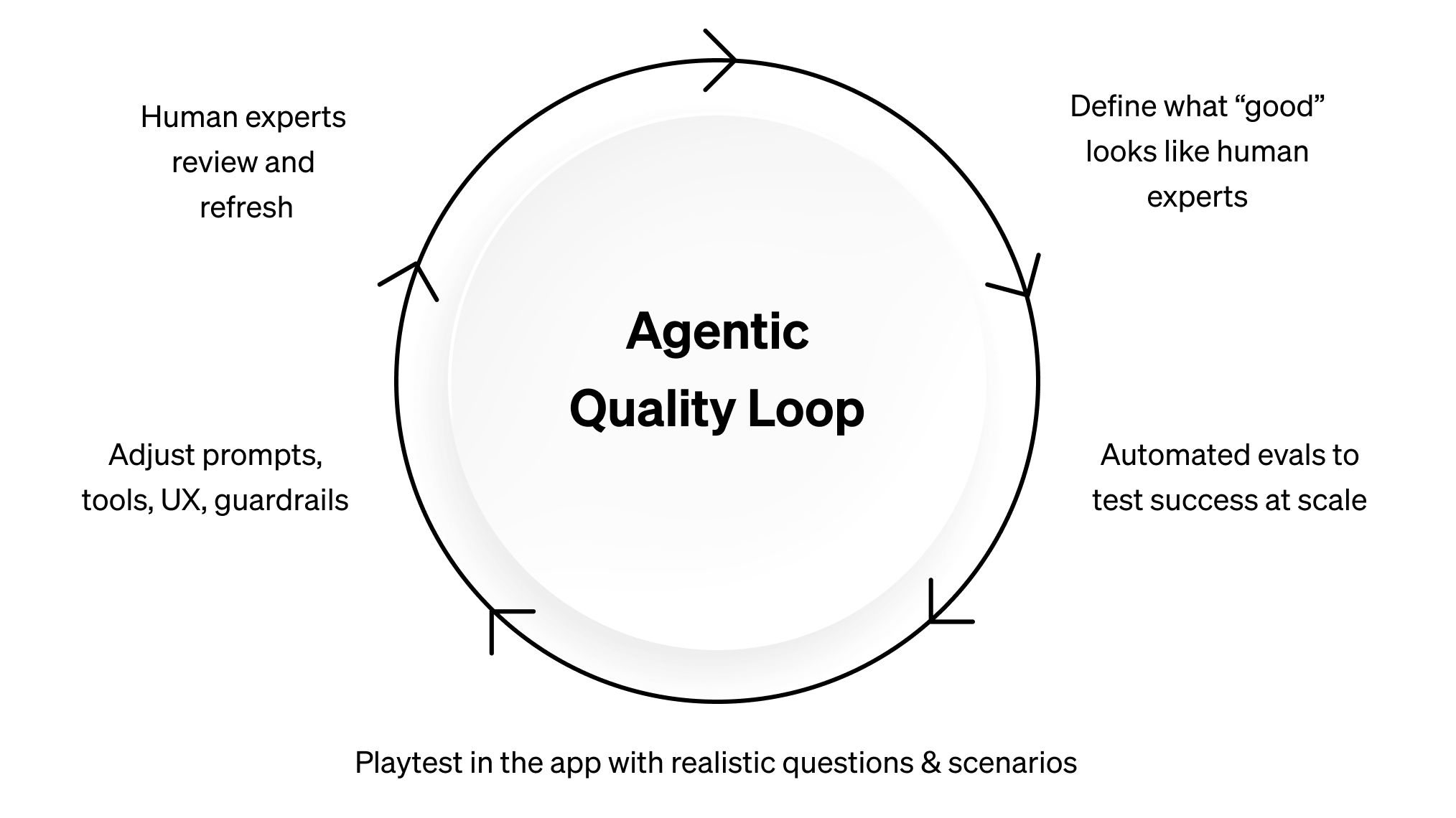
Nayya Intelligence is built on a rigorous, multi-layered governance model—combining human expertise, automated evaluations, and continuous testing to ensure every answer is accurate and grounded in real data.

Agentic Quality Loop

Accuracy is built in layers. Our experts curate the data sets that define what "good" looks like, automated evaluations measure performance at scale across thousands of scenarios, and continuous playtesting ensures what works in testing actually works when employees need help in the moment.

Human-in-the-loop

Every answer is grounded in over 100,000 hours of human expertise, from actuaries and benefits specialists to clinical coders, so the people who know benefits best are always part of the intelligence layer.

When AI does not know the answer or encounters an edge case

We have specific fallback logic for situations where the agent does not have the capability to answer a specific question. In situations where a user asks a question about data that is unavailable to the agent, the system is designed to alert the user that we do not have the requisite information required to answer the question. When confronted with a complex scenario or edge case, the agent asks clarifying questions to determine the user’s intent.
Nayya upholds the highest standards in data privacy and security—including HIPAA, SOC 2 Type II, HITRUST, CCPA, ADA, WCAG AA 2.1, and NIST 800. Customer data is never used to train AI models, never shared with third-party vendors, and only the minimum data required to answer a question is ever in scope.

Do you use Customer Data to train LLMs?

No. Customer Data is not used to train any LLMs used in our products.

What personal information will the AI platform see?

Only the minimum data needed to support the use case. We design the experience so the AI can operate without pulling in unnecessary HR, benefits, or health information.

What guardrails are in place to prevent the AI from exposing sensitive data?

We use practical safeguards such as data minimization, scoped permissions, and controls designed to prevent the AI from returning sensitive identifiers unless explicitly required and authorized. Access and key actions are logged for auditability.

Does Nayya protect sensitive health data?

Yes. We treat health and benefits data as highly sensitive and protect it with encryption in transit and at rest, strict access controls (least privilege), and continuous logging and monitoring. We also maintain a formal security and compliance program, including SOC 2 type 2 controls and we support HIPAA-aligned safeguards and processes for workflows involving protected health information.

Intelligent from the outset

5M+
employees served
15M+
claims processed annually
100K
experts review hours
5M+
plans ingested
2021

Connected claims to benefits for the first time

Nayya combines medical claims data with benefits data, enabling targeted communications that help employees understand and act on their coverage.
2022

Expanded across the full benefits spectrum

Claims data powers plan selection matched to real utilization patterns, with coverage expanding to supplemental products including accident, life, and more.
2023

Laid the foundation for Claims intelligence

Nayya builds a structured claims intelligence framework and begins prototyping BenefitIQ, shifting from data aggregation to understanding the rules that govern benefits.
2024

Turned Claims history into actionable signals

Nayya Claims synthesizes complex medical data into a complete financial and health picture, identifying reimbursement opportunities across supplemental plans.
2025

Benefits Structure goes live

A dynamic, programmatic model representing virtually any benefit, enriched with leave logic and Northstar's financial wellness knowledge base.
2026

Nayya Agentic Platform launches

Universal Claims and Nayya Agentic Platform combines years of modeling to answer complex benefits questions with both breadth and specificity.
TODAY

Today and beyond: The platform keeps getting smarter

Every interaction makes the intelligence more precise. The more Nayya learns, the more personal the answers become.

Nayya in the news.

View All